
Ga Hock Seafood: Salt Baked Crabs!


Salt Baked Crabs $130 (Two large)

If you are a crab lover, you would no doubt have heard about Ga Hock's salt baked crabs.  I have been wanting to eat at Ga Hock for the longest time, but never managed to get down to it till now.

I had always imagined the salt baked crab is like salt baked chicken where the whole crab is encrusted in salt and then baked in the oven.  So when the crabs were finally presented to me, it was a bit of an anticlimax.  It looked like the crab was just dusted with pepper and salt and baked in the oven!  So simple ah?  Looks like something that I can do at home!

When crabs are cooked so simply, a lot will have to depend on the quality of the crabs.   If you are a crab lover, you would no doubt have felt the pinch of the increasing prices of crabs in the last few years.  So when you have to pay $65 for a 1.5kg crab, you would expect it to be solid.  As it turned out, I was actually quite disappointed with the salt baked crab.  We ordered one male and one female crab.  The male had nice large claws which were only half filled.  The meat was on the female crab was solid enough but I couldn't help but go away feeling that we could have spent much less buying our own crabs and baking it ourselves.  Afterall, when you pay so much for crabs, you would expect that the crabs meet up to a certain standard.  To be fair, after the meal, I enquired about the quality of the crabs and was told that if we had told them about it before we started eating, they would have been happy to exchange the crabs for us.  That being said, I still felt that if they have a one to one exchange policy with the supplier then it would have been much better if  they would automatically switch to a meatier crab when they crack open the shell and see the lack of meat in the claws. Tastewise, you really don't need to stretch your imagination too much to know how salt and pepper would taste with crab.  4/5


Butter Sotong $21

The dish that I really fell in love with that day were the butter sotong.  They reminded me of the sotong I always eat when I am fishing in Rompin.  I would go so far to say that it is my favourite way of cooking sotong.  Tender on the inside with a crunchy crust which has enough sauce to flavour it but maintaining its crispiness, it is really a no brainer.    4.5/5


Fish Head Curry $23 (Half head)

Fish Head Curry is the other signature dish of Ga Hock.  The gravy was very good.  It is nonya style fish head curry, so the gravy was rich and coconutty.   The half head we were given was unfortunately not too fresh that day and I felt it was a tad small for the claypot.  Perhaps it is another sign of the diminishing supply of seafood?  3.75/5


Sambal La La $12

We had two dishes that evening which made use of their sambal chilli sauce and they were very good.  There is no lack of hae bee (dried shrimps) in the sambal, so both the sambal la la and the sambal kangkong were spicy, savoury and shiok!  4.25/5


Conclusion

My personal experience at Ga Hock did not really live up to expectations, but my friend SCS Butter who eats there every month tells me that it was just a one off.   Apart from the food, Ga Hock does have that rustic environment going for it.  When you are eating there, you can just imagine that you are somewhere in Malaysia.  I think it does deserve a return visit for me if not just for the butter sotong. But next time I will be wiser to complain about empty crab claws and get them to replace it before tucking in!

Ga Hock Seafood
794 Upper Bukit Timah Road
Singapore 678133
63145725
4pm to 11pm

Nasi Bawean: Cooking with Charcoal since WWII!


Stingray Assam Pedas

I have been wanting to blog about Nasi Bawean from the very early days of the blog but somehow I didn't manage to get around it until recently.  The problem is that the stall is so popular that it often sells out by the time I finish seeing my last patient and rush down for lunch.  However, my friend, SCS Butter told me that lately they have been closing a little later because of some road works that are being carried out just outside the shop which is affecting their visibility.  So I quickly took the opportunity to make my way down to this very popular Nasi Padang joint.


Assam Pedas cooking over charcoal

This Nasi Padang is located in an old coffee shop which exudes the kind of old world charm that is fast disappearing from our rapidly changing landscape.  I wasn't at all surprised with the coffee shop owner told me that Nasi Bawean has been around since WWII!  It certainly looks it.  Now any food establishment's longevity can usually be attributed to really good food and Nasi Bawean is no exception.


Ayam Kecap Manis

Part of the reason why their food is so good is because they are still cooking things with good old charcoal, the way that it has been done for the longest time.  You might be wondering how cooking over charcoal can make things taste better than  when it is cooked over gas?  Well, the truth is, I don't really know.  But it does have something to do with the different way heat from charcoal and gas is dissipated.  A pot of water cooked over charcoal doesn't over boil.  It just keeps simmering away slowly.  That is why charcoal is still the preferred way to keep a kettle of water hot when you are enjoying gung fu tea with friends.  You just have the leave the water over the charcoal and you don't have to bother about adjusting the heat as you would with an electric or gas kettle.


Beef Rendang

The food here is very good.  Although it is named Bawean after the small island off Surabaya, Indonesia where the family originated from, the dishes have more or less evolved to take on the characteristics of the more familiar Nasi Padang dishes that we see here in Singapore. I would recommend the Stingray Assam Pedas, Ayam Kicap Manis and Beef Rendang here as they are excellent.  4.5/5

Conclusion

It doesn't get as old school as this!

Nasi Bawean
62 Desker Road
Singapore 209587
10.30am to 3pm
Closed Sundays
93399433

Carrot Cake (Chai Tow Kueh) Recipe: With Japanese Radish!


Homemade Chai Tao Kuay

I have been wanting to write this carrot cake recipe ever since Chef William Soh wowed everyone with his carrot cake during our Ultimate Hawker Fest last year.   As with many of my other recipes which I have blogged about, there is always the question of "Why Bother?" since you can just go to the hawker centre and have a nice plate of carrot cake for $2?

Well, there are several reasons I am writing about carrot cake.  Firstly, I want to encourage young hawkers to come up with a better carrot cake than what we are having right now.  I hear of the legendary Lau Goh, who started the white carrot cake revolution in years gone by and I ask myself, "Why not?".  I see the last remaining hawker at Bukit Merah View Carrot Cake still milling rice to make their own carrot cake and I ask myself  "Why not?".  And every time I eat carrot cake, I always mull over the fact that I can't even taste the carrot (radish actually) and I ask "Why not?"

My dream is to see someone starting a little shop that has a space in front where rice is milled to make carrot cake that is chock full of white radishes.  Then another part of the restaurant where it is expertly fried over a smoking cast iron pan to perfection. Think of the Soba restaurants in Japan and ask yourself, "Why not?"

I don't know if I will ever see that happening, but until that day dawns, here is my small contribution to get the stone mill rolling.  Hopefully, a smart entrepreneur might just pick up on the idea and give the world a carrot cake to behold.  A carrot cake that is sublime as the best Soba noodles in Japan.  "Why not?"

Before we get started, let me just add this disclaimer.  What I have done here is certainly NOT the ultimate carrot cake. I would give myself only a 4.25 at best, but it is certainly better than a lot of carrot cake that I have eaten elsewhere.  One thing though, this is a carrot cake which you will be able to taste the radish.  So I am hoping that this recipe will get you started on making your own carrot cake which is a hawker dish that one can easily make at home.


Ingredients: (Courtesy of Chef William Soh)

Rice Flour 250g
Tapioca flour 10g
Wheat flour 10g
Salt 5g
Sugar 15g
MSG 10g (optional)
Radish 500g
Water 1.25L (900ml for radish, 350ml for flour)
Chye Poh - 1 packet
Garlic - 2 cloves
Pork Lard 250g (optional)

Notes on ingredients:

1.  Radish: Since I was making my own carrot cake, I went for the best and got myself a Japanese Daikon.  It is of course more expensive than the local ones which you can buy from the local markets.  But at $5.60 per daikon which weighs around 1 kg, you can make quite a lot of carrot cake, so it is still quite affordable.  If you are buying the ones at the market, go for the ones from Cameron highlands instead of the ones from China.  According to the Carrot Cake Uncle at Fu Ming, they are better for making carrot cake.

2.  Chye Poh:(Preserved turnips) There are two types of Chye Poh in the market, a sweet or a salty version.  Most carrot cake places use the salty version.  However, I actually like a bit of sweetness in my carrot cake so I mix both.  The taste is really up to your preference.

3.  Rice flour:  If I had it my way, I would grind my own rice flour with a stone mill using Thai Jasmine rice.  But I don't have a stone mill (yet), so the best alternative is to buy the ready milled rice flour from the shops.  Make sure it is the wet milled type and not the dry milled type which is used to make batter for deep frying. 

Steps:

1.  Cut the radish into strips which are about twice the size of matchsticks.  Cutting the radish is better than shredding it because when you shred it, the juices tend to leech out of the radish.  Cutting it also means it is a little thicker and so it gives it a better bite.

2.  Mix the rice flour, tapioca flour, wheat flour with 350ml water into a thick slurry.

3.  Heat up the water in a separate pot and add salt, sugar and msg (optional).  In the photo, you will notice that I added some dried cuttlefish to the water.  I did this in place of msg to give the stock a bit of umami flavour.  You can use other alternatives to msg such as konbu, ikan bilis, dried scallops etc.  You can of course use a bit of chicken stock powder but just take note that it is as good as adding msg.  So if you are doing it as a shortcut to making your own chicken stock then it is ok, but if you are trying to avoid msg, then it is not ok.

4.  Once your stock is ready, add the radishes into the boiling water and cook until the radish turns translucent. (5-10mins)


5.  Next add the flour mixture to the radish and stir until it has thickened evenly.

6.  Oil the pans and then add the thicken mixture.

7.  Steam for 2 hours and leave overnight in the fridge to set.


Now we can prepare the condiments

Pork Lard (optional)
1.  Render the pork lard by cutting the fat into cubes and letting it render over a slow fire (takes around 30 mins).  You can add some pandan leaves for flavouring.

Chye Poh
1.  Finely chop two cloves of garlic and add them to the Chye Poh.  Add some pork lard or vegetable oil and cook until the chye poh turns brown.  You may add some sugar if you prefer your chye poh to be sweeter.


Instructions on frying

If I had my way, I would have a nice flat cast iron pan to fry the carrot cake over a charcoal fire.  But since this recipe is for home use, I have taken Chef William's advise to use a non stick pan.  It actually works pretty well and is more practical for most people. 

1.  Cut the carrot cake into 2 cm cubes. 

2.  Add oil to the pan and when it is hot, add the cubes of carrot cake.  Press the carrot cake down gently onto the pan so that it breaks.  This creates an irregular surface which enables the chye poh and fish sauce to stick to.  This is much better then chopping the carrot cake with a knife into smaller cubes as you get only smooth surface on your carrot cake that way.  That is why its better to start with larger cubes and break it into irregular shaped smaller chunks. The aim is to have some large pieces where you can taste the rice and radish and some smaller pieces that get charred and coated with chye poh and fish sauce.

3.  Add fish sauce and continue to fry

4.  Add Chye Poh mixture and continue to fry till it develops and nice crust.

5.  Add eggs and fry till brown.  Serve with chopped spring onions and a dash of white pepper


No egg version

Black Version

1.  With the black version, add the dark sauce towards the end of the frying process.  Fry till you develop some crust on the carrot cake and then reduce the heat and add the sweet black sauce.  Toss until evenly coasted.  Then turn off the fire and add some more sweet sauce, stir fry till even and then serve. (Note:  Sweet black sauce turns bitter if subjected to too much heat)

Conclusion

Hope you all enjoy the recipe and do let us know how your carrot cake went!

Acknowledgements


Many thanks to Chef William Soh for sharing his family recipe!  Chef William grew up helping his father at their carrot cake stall. He recalls spending his time as a kid, fanning the flames of the wood fire which is used to steam their carrot cake!

A Noodle Story: Is this what the nex gen Singapore Noodles looks like?


Singapore Ramen $5

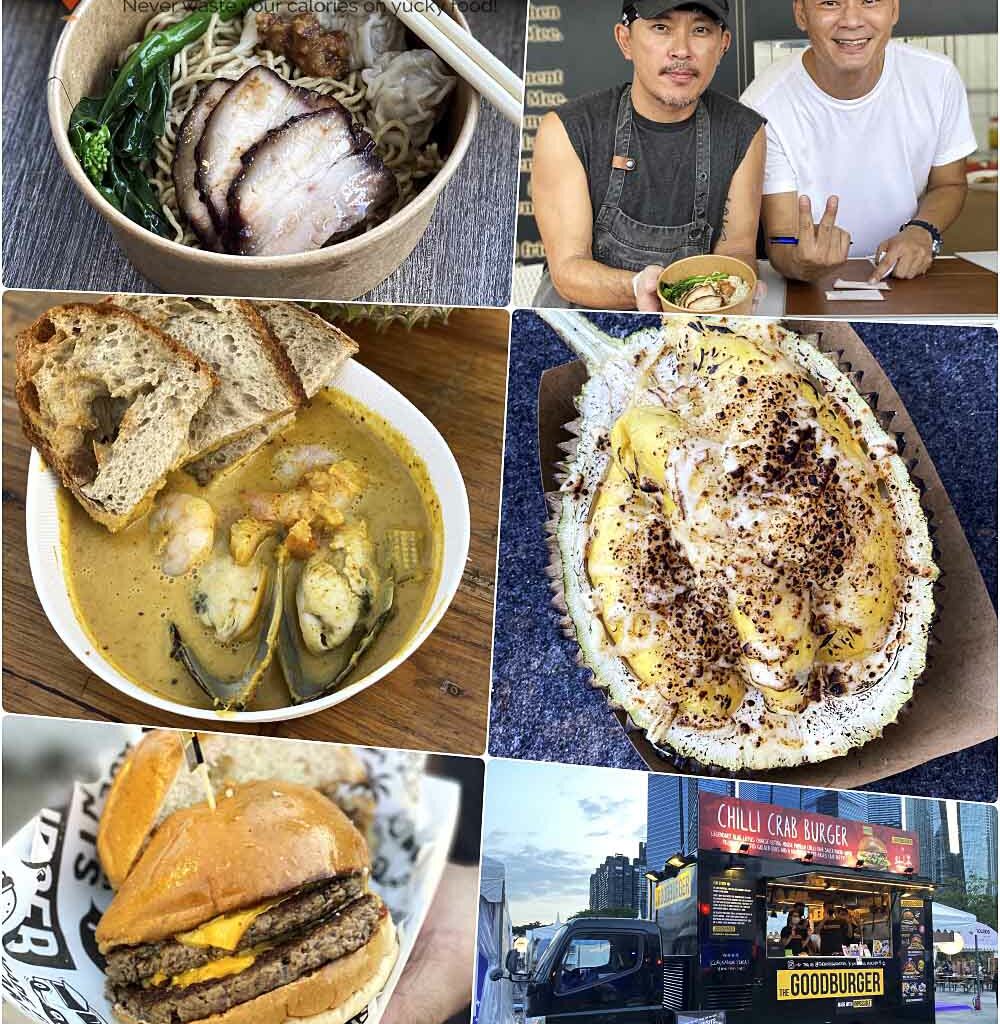
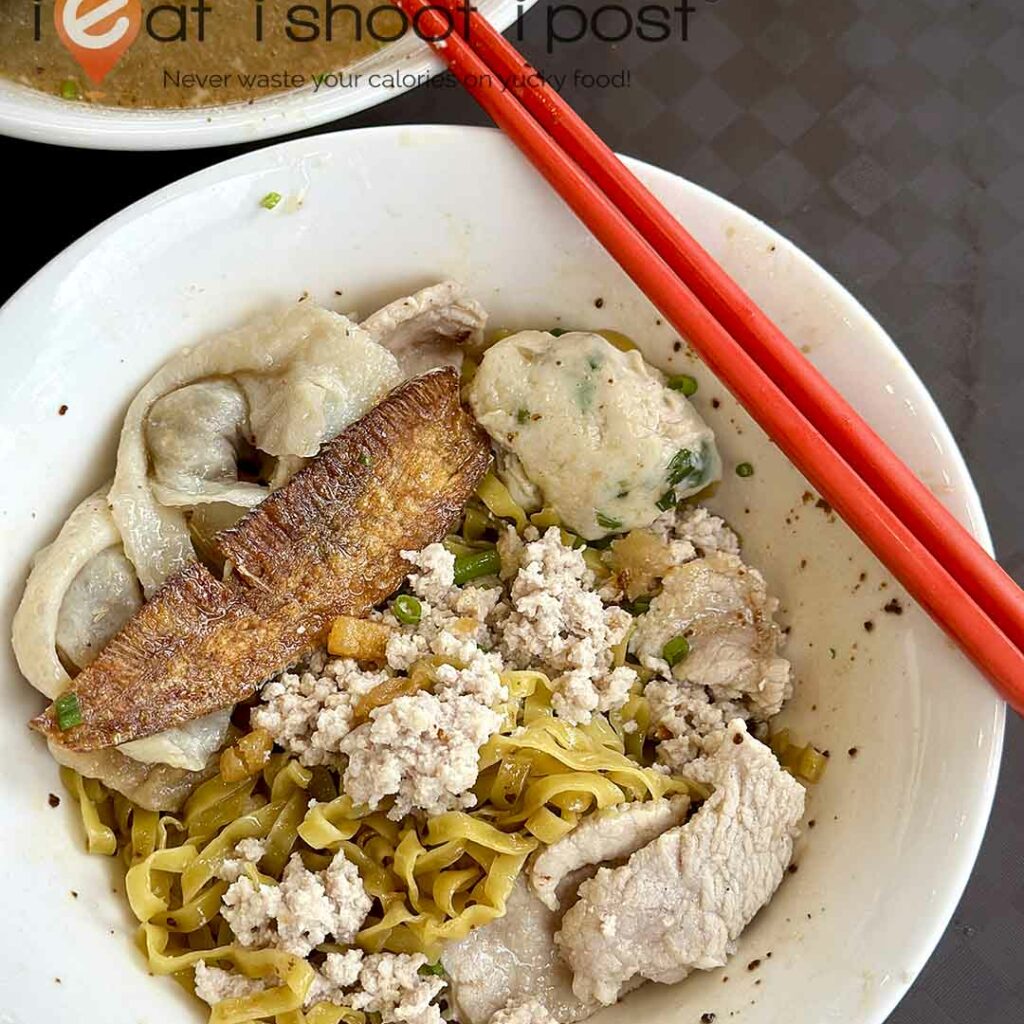
Is this the future of Singapore's hawker food?  A bowl of Wanton Mee that has elements of both Japanese Ramen and traditional Wanton Mee? Some might applaud it for being innovative, perhaps the next stage in the evolution of our heritage hawker food.  Others might consider it a cheap and poor imitation of the Japanese Ramen.  That such a bowl of noodles should appear in our local culinary scene is inevitable.  Firstly, our young chefs are being exposed to a myriad of new and exciting ingredients and are keen to make use of new ideas to give potential patrons a novel gastronomic experience. The second reason, I believe is basic economics.  Call it "Ramen" and you can sell it for $5, $6, $7.  Call it wanton mee and people will complain that even $4 is too expensive.  So if you are a new generation hawker, what would you do?


Gwern and Ben

There is no lack of culinary talent in Singapore.   And for those who have a more entrepreneurial spirit, the hawker centre is a cheap and viable incubator for their culinary ideas.  Gwern and Ben are two such individuals.  Both were trained at Shatec and have spent some time in some of Singapore's most well known restaurants.  Iggy's, Waku Ghin, St Pierre and Restaurant Andre have been listed in their respective resumes.  But the itch to start something on their own is too great, so the pair ventured our on their own to create the bowl of noodles of their dreams.


So just what do their envision their perfect bowl of Wanton mee to be?   Well, let's start with the noodles.  They use the Hong Kong style wanton mee which is thin, springy and lots of bite.  Wonton is a must, so that is part of the dish.  Singaporeans like chilli, so they made their own blend of sambal chilli.  For the sauce, they specially make an oil that is scented with lemongrass, pandan leaves, onion and garlic.  In case you think this is a rather weird combination, just think of chicken rice and everything will make sense. For flavouring, they use a combination of dried prawns and konbu to impart flavour to the noodles.  The noodles are then topped with a generous amount of chopped shallots.


Instead of using BBQ char siew, the duo have decided to go the direction of the Japanese Ramen by giving Japanese Charshu as well as Japanese style braised egg.  They use belly pork from Spain, marinated and cook it for 36 hours in a water bath.  What results is a very tender pork belly which still holds much of its shape when sliced.  The texture is perfect but flavour is a bit lacking because they omitted the Sake and Mirin in order to save on cost.  A bit of a shame, but if you really want the real deal, then you have to be prepared to pay more than $5 for your bowl of noodles.  So it's a compromise.

The other item which you might have noticed is the potato wrapped prawn fritter.  It adds some crunch to the whole dish, but I feel that it is a little out of place.  They don't make it themselves, it just comes out of a packet and they deep fry it.  They have made everything else with such passion that this extra topping just doesn't seem to belong there.  I would rather they added a nicely fried sui gao (prawn dumpling) instead.

Overall, I think that it is a commendable effort.  In terms of effort, I give the guys top marks.  It is good to see the next generation of hawkerprenuers making use of their training and understanding of ingredients to bring our hawker cuisine to the next level.  In terms of taste, I give it a 4/5 for the moment.  The whole thing just did not come together for me.  The flavour of the lemongrass scented oil, konbu and dried shrimps sounds good on paper but it just lacks that eye popping oomph that would bring you back again and again.  The toppings of the Charshu and braised egg were good but they since they held back on the sake and mirin, the flavours just failed to reach a crescendo. 

However, the duo assured me that they are still experimenting and tweaking the flavours, so I can only say that it can only get better.

Conclusion

So what do you all think?  Should young hawkerpreneurs stick to traditional recipes or venture out to fuse new influences and flavours to our food?  Personally, I would prefer if they had made an ultimate next generation Wanton Mee rather than a Singapore Ramen.  That would mean using their skills to create the best sauce, chilli, wanton and char siew and put it together to surpass what our older generation hawker masters have done.  I believe that there is a great need for our next generation hawkers to be encouraged to make and sell our traditional hawker foods.  But it needs to make economic sense or else they will end up selling Ramen or Pasta.  It really is up to us discerning foodies to indicate that we are willing to put Wanton Mee and Ramen on a level playing field.  If a plate of wanton mee can be made with as much passion and attention to detail as a bowl of Ramen, would you be willing to pay $5 or $6 for it?  If the answer is yes, then the future of our hawker tradition is secure.  However, if we continue in our culinary prejudice, then the hawker centres of the future will be filled with pastas, ramen and fusion noodles. 


A Noodle Story
Amoy Street Food Centre #01-39
7 Maxwell Road, Singapore 069111

10am - 7.30pm
Closed on Sat/Sun/PH

Frontline: How to preserve our Hawker Heritage?


Here is the episode of Frontline first aired on Ch 8 on 3 May 2013 at 10.30pm.  Thanks to Sen for the video upload!

Here are two of the stalls that were featured:

1.  Xiao Di Hokkien Mee
2.  Heaven Putu Mayyam

Here is the bottomline:


If we want to be able to eat good, traditional hawker food in the future, we need to nurture the next generation of hawkers now!  If we continue to complain whenever a young hawker raises the price of his plate of Hokkien Mee by 50 cents, then he will end up selling pasta instead!

Fu Ming Carrot Cake: It don't matter if it's black or white


White Carrot Cake $3

I have been a little bit crazy over carrot cake lately and have been on a quest to create the ultimate carrot cake at home.  I have tried several different recipes and I am just about finished with a recipe which I will blog about soon.

Before you can try to come up with the ultimate carrot cake recipe, you must first define what the ultimate carrot cake is supposed to be like.  This is where the difficulty lies.  As you may well know, carrot cake takes on two broad forms in Singapore. One is the white variety and the other is the black.  Within the white variety, there are many variations.  Some hawkers like to chop the carrot cake into tiny pieces and then add the egg, fashion them into tiles then fry them to a crisp.   This is the style of the famous Chey Sua.  The two carrot cake stalls at Upper Bukit Timah food centre, viz He Zhong and Seng Kee also fry them into tiles but they tend to be thicker and more eggy.  Then there are the more traditional style where they don't form them into tiles but fry the carrot cake haphazardly, much like any fried kway teow or noodles.  This is the style that Fu Ming employs.  At this stage, I am leaning a little more towards this style of Carrot Cake.


I was first alerted to Fu Ming by one of our makan kakis, Metranquility, who told me about this particular Carrot Cake at Redhill which has that elusive wok hei.   When I visited the stall and saw the smoke rising from his cast iron pan and the carrot cake steamers at the back of the stall, I could see blinking neon lights appearing over the man's head, spelling "HAWKER MASTER ALERT"!


Home made Carrot Cake

It might come as a surprise to you, but there are actually still quite a few hawkers who are still steaming their own carrot cake.  One would have expected that most of them would simply buy them from factories nowadays.  Of course, the majority of carrot cake stalls do procure them from factories, especially the ones from the food courts.  But if you bother to look around, there are still quite a few hawkers that persist in steaming their own carrot cake.  This is one of the criteria I look for when deciding whether to write about a particular stall.


A while ago I wrote that most carrot cake stalls are either good for the white or the black carrot cake. This is usually the case for most places but not so at Fu Ming.  Both the white and black versions are excellent. 
He employs different frying techniques for the each version.  With the white version, he makes sure that the cake is chopped roughly so that there are big and small pieces.  The big pieces allow you to enjoy the soft texture of the cake and the flavour of the radishes while the smaller pieces get charred quickly so that you get to enjoy the crispy charred crust.  If I have anything to complain about, it is that I would have liked some the dish to be topped with some freshly chopped spring onions for extra fragrance. But I guess I shouldn't complain too much about an expertly fried homemade carrot cake which starts from $2 a plate.  4.5/5


With the black version, the crust is not so important since the black sauce will soften the crust even if it forms. However, he employs a different technique where he adds the sweet sauce twice;  once in the middle of cooking and another time just before he serves it on the plate.  That is why his black carrot cake glistens with a sexy dark appeal when he passes you the plate! 4.5/5

Conclusion

This uncle really embodies everything that we like about hawker food.  It's cheap, it's good and it's made with dogged passion!


Fu Ming Carrot Cake
Redhill Food Centre
Blk 85 Redhill Lane
Singapore 150085
12pm to 12am
96410565, 64758653


Napolizz Pizza: Italian Style Takeaway Pizza


Magherita $19 (1 for 1 takeaway)

Finally!  A takeaway pizza place that is worth the calories!

Good news for pizza lovers who are looking for the thin crust, restaurant style pizza but don't want to have to sit down in a restaurant to eat it.  More importantly, you don't need to pay GST and service charge on top of an already overpriced pizza. What's even better is that you can buy two such pizzas for the price of 1!  That means for $23, you can simply drop by the little stall and take away two rucola and parma ham pizzas in takeaway boxes and get a quick pizza fix!


Parma and Rucola $23 (1 for 1 takeaway)

Now, here's the caveat. Although the restaurant is called Napolizz and they claim to sell authentic Napoletana style pizza, let me just say that not everyone is familiar with the definition of a Vera Pizza Napoletana (True Pizza Napoletana) that has been stipulated by the Associazione Verace Pizza Napoletana. Over the years, I have written extensively on the subject of the Vera Pizza Napoletana and I must admit that I have become somewhat of a pizza snob.  So what Napolizz is selling is NOT a Napoletana style pizza.  The oven is wrong, the crust is wrong, the sauce, toppings etc etc, they all don't conform to what is a Vera Pizza Napoletana.

Having said that, the pizzas are still very good in its own right and should appeal to the current Singaporean pizza palate which is still leaning towards a thin crust style pizza with the edges that are crisp like a water cracker.  Toppings wise, they are of the restaurant standard.  You do have a choice of Buffalo mozzarella, Rucola, Parma Ham, shaved Parmaggiano Reggiano and other ingredients which the Italian restaurants are using.  I am just happy to be able to find a decent pizza that costs $11.50 that the kids love and I actually enjoy.  4.25/5


The guy behind this idea is Negan, a 29 year old chef who had been working at various Italian restaurants and seeing how profitable pizza actually is, decided to come out on his own.  His concept of just having a little takeaway shop for restaurant style pizza is brilliant and I feel that as long as he has the one for one promotion and maintains the quality of the pizza, he should be getting a queue outside his little pizza shop very soon!

Conclusion

We have been back three times for his pizza already.  The kids love it, I like it. It's quick, cheap and good.

Napolizz Pizza
396 Upper Paya Lebar Road
Singapore 534984
12pm to 10.30pm
62808220
www.napolizz.sg

LinkWithin

Related Posts with Thumbnails